




Serengeti National Park: Everything You Need to Know Before You Go
Planning a Serengeti safari with kids? Discover what it’s really like to explore Tanzania’s famous national park, from spotting lions and cheetahs to staying in a tented camp in the African wilderness. Based on our own family safari, this guide covers the best time to visit, wildlife, accommodation, game drives and practical tips for planning your trip.
Some holidays are all about relaxing by the pool. Others involve theme parks, road trips or exploring a new city. And then there are holidays where you find yourself sitting in a jeep, watching three young lions feeding on a carcass just a short distance away.
Our family safari in Tanzania was definitely the last kind.
In July 2022, we travelled to Tanzania with our daughters, Anneloes and Evelijn, who were nine and five at the time. We wanted to experience an African safari, see incredible wildlife and spend time somewhere completely different from our everyday lives.
We decided to spend one week exploring Tanzania’s national parks and another week relaxing on Zanzibar. A little adventure followed by a tropical beach holiday sounded like the perfect combination.
And it was.
The Serengeti was one of the highlights of our trip. We saw an entire pride of lions resting on a huge rock, came across three adolescent lions feeding on a carcass and spent almost an entire morning searching for a cheetah. We stayed in a tented camp where giraffes appeared outside our tent, and our youngest daughter received something approaching royal treatment from the Maasai staff.
We also discovered that Tanzania can be surprisingly cold in July and that our safari guide, Valance, was exceptionally good at remembering what our youngest daughter liked to eat.
The girls also discovered something about Valance that they found almost impossible to believe: he had never eaten at McDonald’s.
Their reaction was priceless.
In this guide, I’ll share what you need to know before visiting Serengeti National Park, along with our own experiences and the practical lessons we learned along the way.
Because a safari is an incredible adventure, but knowing what to expect makes planning one a whole lot easier.
Disclosure: This post may contain affiliate links. If you book or buy through them, I earn a small commission at no extra cost to you. I only recommend things we've actually used and loved. Thank you for supporting Travel-icious!
Where Is Serengeti National Park?
Serengeti National Park is located in northern Tanzania, in East Africa. It covers approximately 14,763 square kilometres and forms part of the much larger Serengeti ecosystem, which extends beyond the park into neighbouring protected areas, including Kenya’s Maasai Mara.
The park is famous for its vast grasslands, extraordinary wildlife and the Great Migration, when enormous herds of wildebeest and zebras move through the ecosystem in search of fresh grazing and water.
The Serengeti is also a UNESCO World Heritage Site, recognised for its exceptional natural environment and wildlife.
Most visitors exploring Tanzania’s northern safari circuit start in or around Arusha. From there, it’s possible to combine several national parks, including Tarangire, Serengeti and Lake Manyara, with a visit to the Ngorongoro Conservation Area.
That was broadly the route we followed.
We started in Arusha, continued to Tarangire National Park and then travelled to the Serengeti. After our stay in the Serengeti, we headed towards Ngorongoro and Lake Manyara before returning to the Arusha area.
It was a fantastic way to experience different landscapes and wildlife within one trip.
If you’re planning to visit several parks, it’s worth thinking carefully about your route and the time needed to travel between destinations. Distances can be considerable, and you don’t want to spend your entire holiday rushing from one place to another.
In our Tanzania Itinerary: 14 Days of Safari and Zanzibar with Kids, I explain how we combined a week of safari with a week on Zanzibar. For us, this balance between adventure and relaxation worked really well.
What Makes Serengeti National Park So Special?
Before visiting Tanzania, I had seen plenty of safari photographs. Lions in the grass, elephants crossing dusty tracks and giraffes standing against an African sunset.
Beautiful, obviously. But photographs don’t quite prepare you for the sheer scale of the Serengeti.
The landscape seems to stretch endlessly into the distance. You’ll find vast open plains, scattered trees, woodland and rocky outcrops known as kopjes. Depending on where you are in the park, the scenery can change considerably.
And then there are the animals.
You might be driving along, admiring the landscape, when your guide suddenly spots something in the distance. A few minutes later, you’re watching an animal you have previously only seen in documentaries.
Sometimes the animals are far away. Sometimes they’re surprisingly close.
And sometimes you spend an entire morning searching for one particular animal before finally spotting it in the grass.
What I loved most about the Serengeti was the feeling of being somewhere completely different from our normal lives. There was so much space, so much freedom and, in the right moments, an incredible sense of silence.
No traffic jams, no school runs and no emails to answer. Just the landscape, the wildlife and the occasional question from the back seat about when lunch would be served.
The Serengeti is also one of the world’s best-known wildlife destinations because of the Great Migration. Millions of wildebeest, accompanied by zebras and gazelles, move through the wider ecosystem as they search for fresh grazing.
The exact location of the herds changes throughout the year, depending on rainfall and grazing conditions.
However, you don’t have to witness the Great Migration to appreciate the Serengeti. The resident wildlife, spectacular scenery and unpredictability of every game drive make it an extraordinary destination in their own right.
What Animals Can You See in Serengeti National Park?
The Serengeti is famous for its predators, large herds of grazing animals and incredible biodiversity.
You may encounter lions, cheetahs, leopards, elephants, giraffes, zebras, wildebeest, buffaloes, gazelles, hyenas and numerous bird species.
Of course, wildlife sightings are never guaranteed. These are wild animals, not performers following a timetable.
Fortunately, we had some unforgettable encounters during our visit.
Lions on Top of a Giant Rock
One of my favourite sightings was an entire pride of lions lying on top of a large rock.
We drove around the rock to see the lions from below. It was already an incredible sight, but there was something else that made the moment even more memorable.
A lion would only have to jump, and it could be standing on the roof of our jeep.
Let that thought sink in for a moment.
We were sitting in our vehicle, looking up at a pride of lions, suddenly very aware that we were visitors in their world.
The Serengeti is full of rocky outcrops called kopjes. These formations rise above the surrounding plains and provide places for animals to rest and shelter.
Apparently, they also make excellent lion lounges.
Seeing an entire pride on top of one was one of those moments that made us realise just how special a safari can be. You can read about wildlife and see photographs beforehand, but being there yourself is something entirely different.
Three Young Lions and a Carcass
We also came across three adolescent lions feeding on a carcass.
And when I say we came across them, I mean we were right next to them in our jeep.
There they were, three young lions busy feeding while we watched from the vehicle. It was fascinating to see them so close, going about their business in their natural environment.
It’s one thing to see lions in a wildlife documentary. It’s quite another to sit in a vehicle nearby and watch them for yourself.
Of course, these are wild animals, and being close to them is a reminder to follow your guide’s instructions and remain in the vehicle unless told otherwise.
But what an experience.
Between the lions on the rock and these three young lions, we certainly had our share of memorable lion sightings.
The Cheetah We Had Been Searching for All Morning
We also really wanted to see a cheetah.
Finding one turned out to require a little patience. We spent pretty much the entire morning driving around and searching.
Eventually, we spotted one, and it was absolutely worth the wait.
There was just one small challenge: cheetahs are surprisingly difficult to spot in the grass.
Their coats blend in so well with the surrounding vegetation that you really have to look carefully. Even when you know where to look, it can take a moment to distinguish the animal from the grass around it.
After spending so much of the morning searching, finally seeing a cheetah felt like a proper safari reward.
It was also a good reminder that a safari isn’t simply about driving from one spectacular animal to the next. Sometimes you have to be patient, keep your eyes open and trust that your guide knows what they’re doing.
And sometimes, after hours of searching, you finally see exactly what you came for.
The Great Migration
The Great Migration is one of the main reasons travellers dream of visiting the Serengeti.
Millions of wildebeest, together with large numbers of zebras and other grazing animals, move through the Serengeti ecosystem in search of fresh grass and water. Predators follow the herds, creating a constantly changing wildlife environment.
The migration is not a single event that happens in exactly the same place every year. Its location depends on seasonal rainfall and the availability of grazing.
Different parts of the ecosystem are associated with different stages of the migration. If witnessing the herds is your main reason for visiting, it’s worth planning your trip around their expected location rather than choosing dates based on a general calendar alone.
An experienced safari operator can help you decide which area is most suitable for your travel dates.
And remember that nature doesn’t work to a booking confirmation. Even with careful planning, specific sightings cannot be guaranteed.
What Else Might You See?
Lions and cheetahs may steal the spotlight, but there’s much more to discover in the Serengeti.
Elephants, giraffes, zebras, wildebeest, buffaloes and several species of antelope are among the animals you may encounter. The park is also home to leopards, hyenas and a remarkable variety of birds.
Some animals are relatively easy to spot, while others are much more elusive.
Our wider Tanzania safari also took us to Tarangire National Park, where elephants were a real highlight, and Lake Manyara, which had a much greener, more jungle-like landscape.
By the time we reached Lake Manyara, Anneloes had apparently seen enough elephants for one holiday. While we were excitedly pointing them out, she was busy watching YouTube.
Different people, different safari priorities!
That experience also showed us how different Tanzania’s national parks can be. If you’re planning a longer trip, combining several parks gives you the opportunity to experience different landscapes and wildlife.
What Is a Game Drive Like in the Serengeti?
A game drive is the main way to explore Serengeti National Park.
You travel through the park in a safari vehicle with an experienced guide who knows the area, understands animal behaviour and communicates with other guides about wildlife sightings.
Some game drives start early in the morning, when temperatures are cooler and many animals are active. Others take place later in the day. Depending on your itinerary, you may also spend much of the day exploring with a picnic lunch.
Our game drives were full of variety.
Sometimes we were driving through the landscape, looking for animals. Then, suddenly, something interesting appeared. A pride of lions on a rock. Three young lions feeding on a carcass. And, after a long morning of searching, a cheetah hidden in the grass.
You never quite know what the next few minutes will bring.
That unpredictability is part of the appeal, although it helps to have realistic expectations. You may spend a long time looking for a particular animal, and there is no guarantee you’ll find everything on your wish list.
Our cheetah search is a perfect example. We spent much of the morning looking for one, but when we finally spotted it, the wait felt worthwhile.
Why We Chose a Private Safari
We travelled with our two daughters, who were still quite young, and decided to book a private safari.
For us, the flexibility was worth it. We could travel at our own pace and adjust things around the children when necessary.
Our guide, Valance, made a real difference. He was knowledgeable, communicative and funny, and he understood that travelling with children sometimes means adapting the plan.
If the girls were tired, hungry or simply ready for a break, we didn’t have to worry about a vehicle full of other travellers waiting for us.
A private safari isn’t necessarily the cheapest option, so it depends on your budget and priorities. However, if you’re travelling with younger children, it’s worth comparing the cost with the extra flexibility it offers.
The tracks can also be rough, and distances between destinations can be considerable. Having an experienced guide take care of the driving, route planning and wildlife spotting made the experience easier for us than trying to organise everything ourselves.
If you’re comparing different safari options, make sure you understand what is included in the price, how long you’ll spend travelling between parks and what type of vehicle you’ll use.
Safari Lunches: Pancakes, Waffles and the McDonald’s Question
One thing we really appreciated about our safari guide, Valance, was how quickly he got to know our girls.
He soon realised at breakfast that Evelijn was quite a picky eater and that there weren’t many things she particularly liked. So he started paying attention to what she enjoyed in the morning and bringing a little extra along for her lunch.
Did she like the pancakes at breakfast? He’d pack a pancake for later. Was a bread roll more to her taste? He’d make sure she had one. Sometimes, he even brought a waffle.
It was such a thoughtful gesture. Valance didn’t make a big deal out of it; he simply noticed what Evelijn liked and made sure she had something to eat during our long safari days.
As a parent, you really appreciate that kind of thoughtfulness.
But the girls also had another important question for Valance.
They wanted to know about McDonald’s. Had he ever eaten there?
And then came the revelation.
Valance had never eaten at McDonald’s. Ever.
The girls’ eyes grew as big as saucers.
How was that even possible?!
To them, McDonald’s was something so familiar that the idea of someone never having eaten there was almost impossible to comprehend.
Meanwhile, we were sitting in Tanzania, discovering that our guide had somehow managed to live his life without ever having tried a Big Mac.
The contrast was rather funny. We had travelled all the way to Africa to experience something completely different from home, while our girls were busy investigating whether Valance had ever experienced one of the most familiar things in their own world.
And while Valance made sure Evelijn had a pancake, bread roll or waffle to enjoy at lunchtime, the girls were left to wonder how anyone could possibly have missed out on McDonald’s.
Kids, eh? You can show them lions, cheetahs and the incredible landscapes of the Serengeti, and somehow McDonald’s still manages to enter the conversation.
Where to Stay in Serengeti National Park
Choosing the right accommodation is an important part of planning your safari.
Options range from campsites and simple tented camps to comfortable permanent camps and luxury lodges. The best choice depends on your budget, preferred level of comfort, itinerary and the areas you want to explore.
Staying inside the park or in a suitable nearby area can also influence how much time you spend travelling to and from wildlife-viewing areas.
We stayed at Embalakai Tented Camp for two nights, and it became one of the highlights of our trip.
Our Stay at Embalakai Tented Camp
Staying in a tented camp in the Serengeti was a very different experience from staying in a conventional hotel.
We were surrounded by the African wilderness, and the wildlife didn’t always wait until we were out on a game drive.
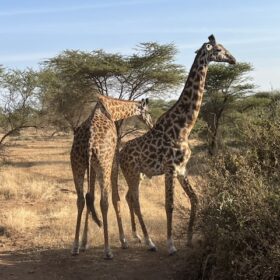
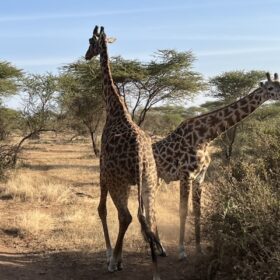
One morning, I was busy doing Anneloes’s hair when I realised there were giraffes outside our tent.
Yes, giraffes.
There I was, concentrating on getting my daughter’s hair sorted, while giraffes were wandering around outside. It’s not exactly the view you get from the average family hotel room.
Moments like that made staying in the Serengeti feel completely different from an ordinary holiday.
The camp itself also gave us the opportunity to experience the landscape in a way that a short visit to the park wouldn’t have done. We weren’t just passing through during a game drive; we were spending the night in the middle of it all.
The Maasai Staff and Evelijn’s Royal Treatment
The camp was guarded by Maasai staff, and there were rules about moving around after dark.
We couldn’t simply wander from our tent to the restaurant on our own. Instead, we had to contact the staff using a walkie-talkie and be escorted.
It made sense, of course. We were staying in the African wilderness, where wild animals roam freely.
But there was another memorable part of the experience.
Our youngest daughter, Evelijn, was small and blonde, and the staff absolutely adored her. She received what can only be described as the princess treatment.
On our evening walks to the restaurant, the Maasai staff sometimes carried her there.
She loved it.
When it was time to leave the camp, we took photos with everyone. The staff had been so lovely with the girls, and it was clear they had a soft spot for our two little travellers.
And naturally, Evelijn had to be lifted into the air one more time for a photo.
Apparently, being carried to dinner wasn’t enough. She needed one final royal send-off!
We laughed, took our pictures and said our goodbyes. The people we meet on our travels often become just as much a part of our memories as the places we visit, and this was a lovely example.
Was It Cold in the Serengeti?
Yes! This is something I would definitely keep in mind when planning a safari in July.
We travelled during the Tanzanian winter. During the day, we were comfortable wearing T-shirts and long trousers. At night and in the early morning, however, the temperature dropped considerably.
We were wearing our thick jumpers during the night and again the following morning.
So, while you might picture Tanzania as a destination where you only need lightweight summer clothes, that isn’t the whole story.
The Serengeti can be surprisingly chilly, particularly before sunrise and after dark. Early morning game drives can feel cold when you’re sitting in a safari vehicle with open sides or an open roof.
My advice? Pack layers.
You’ll want comfortable clothes for the warmer hours, but also a warm jumper, a fleece or jacket and long trousers for the colder parts of the day.
I wouldn’t leave the warm clothes at home just because you’re travelling to Africa!
I’ve shared more practical advice in our What to Pack for an African Safari guide, so you can prepare for both the chilly mornings and the warmer afternoons.
Is Serengeti National Park Suitable for Families With Kids?
Absolutely. Our experience showed us that a safari can be a wonderful family adventure.
That doesn’t mean every moment will be easy or that every child will be fascinated by every animal. Long drives, early starts, bumpy tracks and unfamiliar food can be challenging, especially for younger children.
But the experience can also be incredibly rewarding.
Our daughters saw animals they had previously only encountered in books, on television or in documentaries. We spent time together in a landscape that was completely different from anything we experienced at home.
And, of course, there were plenty of stories to bring back with us.
The giraffes outside our tent, the lions on the rock, the three young lions feeding on a carcass and the long search for the cheetah are all memories we still associate with our Serengeti adventure.
The key is to plan a safari around your family rather than expecting your family to fit into a rigid safari schedule.
Our Tips for a Family Safari
Choose your itinerary carefully. Driving between parks can take longer than you expect. Allow enough time to enjoy the experience rather than spending every day rushing to the next destination.
Consider a private safari. The flexibility can be especially useful with younger children.
Bring familiar snacks. Our experience with Evelijn taught us that knowing what your children like to eat can make long days easier. Discuss meals with your safari operator in advance if you have a picky eater.
Manage expectations. Explain that wildlife sightings aren’t guaranteed. You might see an incredible number of animals one day and spend more time searching the next.
Pack for cold mornings. Our thick jumpers were very much appreciated in July.
Follow your guide’s instructions. Stay in the vehicle unless your guide confirms it is safe to get out, and follow the camp’s rules about moving around after dark.
Think about the pace of the trip. A safari can be intense, particularly for children who are not used to long days in a vehicle. We were glad we had planned a week on Zanzibar afterwards, giving us time to relax by the beach and pool.
If you’re still deciding whether a safari is right for your family, our upcoming guide Safari with Kids: Is Tanzania a Family-Friendly Destination? will offer more advice about what to consider when travelling with children.
When Is the Best Time to Visit Serengeti National Park?
Serengeti National Park can be visited throughout the year, but the best time for your trip depends on what you want to experience.
Weather, rainfall and the movement of wildlife all influence what you may see.
June to October: The Dry Season
The dry season is generally a popular time for safari. Vegetation may be less dense, and animals can be easier to spot in some areas as water becomes more limited.
We visited in July, and it was a fantastic time to experience Tanzania’s national parks.
However, don’t forget the cooler temperatures, especially at night and in the early morning. Our thick jumpers were essential.
The Great Migration may be moving through different parts of the Serengeti ecosystem during these months. The location of the herds depends on rainfall and grazing conditions, so the best area to visit will vary.
November to December: The Short Rains
The short rains generally arrive around November and December.
The landscape can become greener, and the scenery may look very different from the dry-season plains. Rain can affect road conditions, so it’s worth discussing your itinerary with a safari operator before booking.
January to March: Calving Season
The southern Serengeti and nearby areas are associated with the wildebeest calving season, although the exact timing and location vary.
This can be an interesting period for wildlife enthusiasts because large numbers of young animals attract predators.
As always, the experience depends on seasonal conditions and the location of the herds.
March to May: The Long Rains
The long rains generally occur between March and May.
The landscape can be lush and green, but heavier rainfall may make some tracks more challenging and affect travel times.
This doesn’t mean a safari is impossible during these months. It simply means that planning, flexibility and advice from an experienced operator become particularly important.
If your main goal is to see the Great Migration, research the expected location of the herds for your travel dates rather than choosing a month based on a general calendar alone.
For more detail on Tanzania’s seasons and how they may affect your trip, read our Best Time to Visit Tanzania for a Safari guide.
How Many Days Do You Need in Serengeti National Park?
The right amount of time depends on your itinerary, budget and wildlife priorities.
The Serengeti is enormous, and travelling between different areas can take time. You also don’t want to spend your entire visit rushing from one place to another.
For many travellers, two or three nights in the Serengeti is a useful starting point when planning a northern Tanzania safari. A longer stay may make sense if you want to explore more of the park or focus on a particular wildlife experience.
We spent two nights at Embalakai Tented Camp.
That gave us time to experience the landscape, go on game drives and enjoy some unforgettable wildlife sightings.
Our stay was part of a wider two-week holiday. We wanted to experience the safari but also leave time for relaxation afterwards, so we combined a week exploring Tanzania’s national parks with a week on Zanzibar.
For us, that balance worked well. The safari was exciting and intense, and the beach gave us a chance to slow down afterwards.
If you’re planning a similar trip, our Tanzania Itinerary: 14 Days of Safari and Zanzibar with Kids explains how we combined the national parks with a tropical island stay.
How Much Does a Serengeti Safari Cost?
A safari in Serengeti National Park can be a significant investment.
The total cost depends on several factors, including:
- The number of days you spend on safari
- The number of national parks you visit
- Whether you choose a private or shared safari
- The type of accommodation
- The season and availability
- Park entry fees and conservation charges
- Transport, meals and flights
- Whether you combine the safari with another destination
Accommodation ranges from relatively simple camping options to comfortable tented camps and luxury lodges. Your choice can make a substantial difference to the overall budget.
A private safari may cost more than joining a group, but it can offer valuable flexibility when travelling with children.
It’s also important to compare what is included in a quote. Ask whether accommodation, meals, park fees, transfers, drinking water and other relevant costs are included, and check for any additional charges.
Don’t compare two safari prices based on the headline figure alone.
Our trip combined several national parks with a week on Zanzibar. We chose accommodation according to our budget and priorities rather than spending the entire holiday on the most expensive options.
For a closer look at the expenses to consider when planning your trip, see our How Much Does a Tanzania Safari Cost? guide.
Practical Tips for Visiting Serengeti National Park
A little preparation can make your safari much more comfortable. Here are the practical lessons I would take from our own experience.
1. Pack Layers, Not Just Summer Clothes
When you think of Tanzania, you probably picture sunshine, warm temperatures and endless African plains. That’s certainly what I expected, but our safari in July taught us something else: it can get surprisingly cold in the Serengeti!
During the day, we were comfortable wearing T-shirts and long trousers. But at night and in the early morning, the temperature dropped considerably. We were reaching for our thick jumpers, especially during those chilly mornings.
If you’re planning a Serengeti safari during the Tanzanian winter, don’t make the mistake of packing only summer clothes. You’ll want lightweight outfits for the warmer hours, but also warm layers for early morning game drives and evenings at your camp.
My advice is to pack clothes you can easily put on or take off as the temperature changes. A warm jumper, a fleece or jacket, long trousers and comfortable walking shoes are useful additions to your safari wardrobe.
And because safari packing involves quite a few different layers, our compression packing cubes are handy for keeping everything organised. You can separate your T-shirts from your warmer clothes and find what you need without turning your suitcase upside down.
Want to make sure you don’t forget anything else? Check out our What to Pack for an African Safari guide for a more complete packing checklist.
Trust me, when you’re getting ready for an early morning game drive, you’ll be happy to find your warm jumper without having to unpack your entire suitcase!
2. Choose Your Safari Operator Carefully
Your guide can make a huge difference to your experience.
Our guide, Valance, was knowledgeable, communicative and funny. He understood that we were travelling with children and helped make the safari enjoyable for all of us.
Ask potential operators about their experience, the itinerary, the type of vehicle and what is included in the price.
3. Be Patient When Looking for Wildlife
Some sightings happen almost immediately. Others require time and persistence.
We spent much of a morning looking for a cheetah before finally seeing one. It was worth the wait, but it helped to understand that wildlife viewing doesn’t come with guarantees.
4. Plan for Meals and Snacks
Our experience with Evelijn showed us how helpful it can be when your guide understands your children’s preferences.
Valance noticed what she liked at breakfast and brought extra pancakes, bread rolls or a waffle for her lunch. It was a small gesture that made our safari days easier.
If your children have particular food preferences, discuss meals with your operator in advance and bring suitable snacks where practical.
5. Keep Food Secure Around Wildlife
Animals may be attracted to food, so follow your guide’s instructions and keep food stored appropriately.
During our wider safari, we had a memorable encounter with baboons near Ngorongoro. Bananas on the dashboard attracted their attention, and the baboons sat on the vehicle waiting for an opportunity.
It was a useful reminder that food can attract wildlife when you least expect it.
6. Follow Safety Rules at Your Camp
At Embalakai Tented Camp, we had to contact the staff by walkie-talkie after dark so someone could escort us to the restaurant.
Always follow your camp’s instructions about moving around, and never wander off alone in an area where wildlife is present.
7. Bring Binoculars if You Have Them
Animals aren’t always close to the vehicle. Binoculars can help you see details when wildlife is further away.
A camera with a zoom lens can also be useful, but don’t feel that you need expensive equipment to enjoy the experience.
Some of our most memorable moments were simply about being there and watching.
8. Check Current Park Fees and Travel Requirements
Park fees, entry requirements and regulations can change. Confirm the current details with your safari operator and consult official Tanzanian sources before travelling.
You should also check Tanzania’s entry requirements and relevant travel health advice before departure.
Our Travel Tips for Tanzania: Visa, Money, Vaccinations & Safety guide covers the practical preparations for a trip to Tanzania.
9. Put Your Camera Down Sometimes
Of course, you’ll want photographs of the wildlife and landscapes.
But don’t spend the entire safari looking through a camera or phone screen. Some moments are worth enjoying without worrying about capturing the perfect picture.
And, as our family photos at the end of our stay at Embalakai Tented Camp reminded us, not every favourite photograph has to feature a wild animal.
Sometimes, the people you meet along the way become part of the story too.
Is Serengeti National Park Worth Visiting?
For us, absolutely.
The Serengeti was one of the highlights of our family trip to Tanzania. We saw lions on a rocky outcrop, watched three young lions feeding on a carcass and finally spotted a cheetah after spending much of a morning searching for one.
We stayed in a tented camp where giraffes appeared outside our tent, experienced the kindness of the Maasai staff and made memories that went far beyond the wildlife sightings.
We also discovered that even an incredible safari has its practical challenges. July mornings can be cold, children may not be as impressed by picnic lunches as their parents are, and sometimes you need a lot of patience to spot the animal you’re hoping to see.
But that’s part of the experience.
What stayed with me most was the feeling of being surrounded by so much space and nature. It was a chance to step away from everyday life and experience something completely different together as a family.
Would I recommend the Serengeti to other families? Definitely.
It’s an extraordinary destination, and with the right planning, it can be a wonderful way to introduce children to wildlife and the natural world.
Planning Your Tanzania Safari?
A trip to Tanzania involves quite a bit of planning, particularly if you want to combine several national parks with a relaxing beach holiday.
We chose to spend one week on safari and one week on Zanzibar, which gave us a good balance between adventure and relaxation.
If you’re considering the same combination, you can read more about our time on the island in Enjoy Bounty Island Zanzibar. We loved having a week to unwind after the early starts and exciting days on safari.
For a broader overview of the island, including what to see and where to stay, take a look at our Zanzibar: The Ultimate Family Travel Guide.
Need Help Planning Your Family Trip to Tanzania?
Planning a safari, choosing the right accommodation and working out how to fit everything into one trip can feel overwhelming, especially when you’re travelling with children.
At Travelicious, we share our real family travel experiences to help you plan trips that work for your family, from the big adventures to the practical details that make a holiday run more smoothly.
If you’d like help putting together your own Tanzania itinerary, get in touch with Travelicious to discuss your plans.
And if you’re wondering whether a safari is worth the investment, I can tell you this: watching your children experience the African wilderness is something special.
Even if they do ask questions about McDonald’s halfway through.
Read our EVERYTHING YOU WANT TO for more tips and inspiration.
About the Author

Author / Founder of Travel-icious.com
Family travel blogger with 10+ years of experience. Travelling with kids across the globe.