

There are places in Japan that you visit because you really want to see them.
And then there are places you remember because of something that happened there.
For us, Nara is definitely the second kind.
After the bright lights and endless energy of Tokyo with Kids, and the food, laughter and slightly chaotic family adventures of Osaka with Kids, Nara felt like a completely different Japan.
Quieter.
Greener.
Older.
And, apparently, full of deer.
Lots and lots of deer.
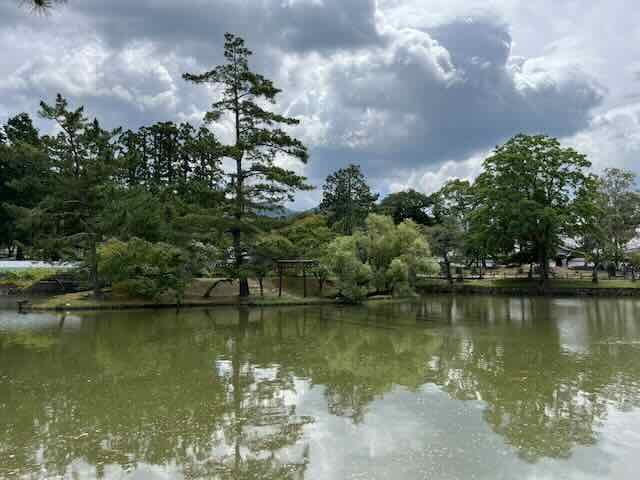
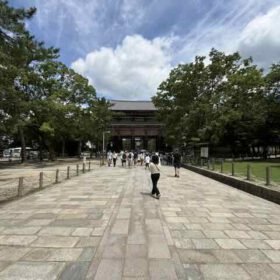
Nara Park is huge, covering around 660 hectares, with ancient temples, wooded paths, gardens and mountains in the background. It is one of those places where you can simply walk without really knowing what is around the next corner.
And that was actually one of the things we loved most about Nara.
It didn’t feel like we were walking from one attraction to the next.
We were just wandering through Japan.
With deer.
So many deer.
Nara was supposed to be a relaxed day
By this point in our Japan trip, we had already experienced the sensory overload of Tokyo and the energy of Osaka. We were also looking forward to Kyoto, which would bring another side of Japan entirely.
That is one of the things I love about travelling through Japan with children.
Every city feels different.
Tokyo was futuristic and enormous. Osaka felt lively and wonderfully informal. Kyoto would be all about temples, traditional streets and those moments where Japan almost feels frozen in time.
And then there was Nara.
Nara is one of the oldest cities in Japan and was Japan’s first permanent capital. Its history stretches back more than 1,300 years, and the area around Nara Park is filled with some of the country’s most important temples and shrines.
But honestly?
Our children weren’t thinking about any of that when we arrived.
They were thinking about the deer.
And there were already plenty of them.
And then we met the deer
At first, everything was fine.
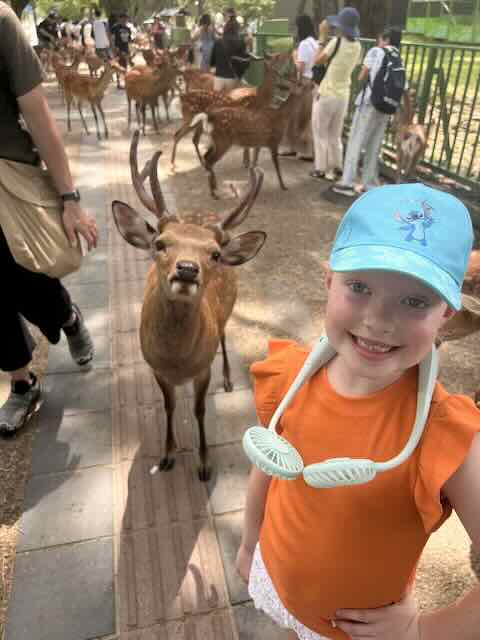
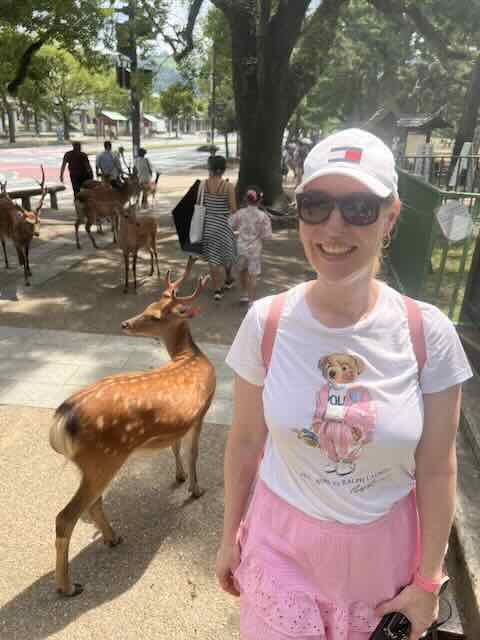
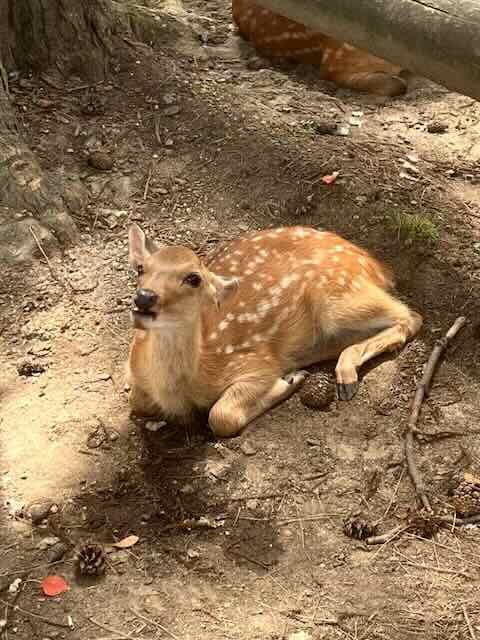
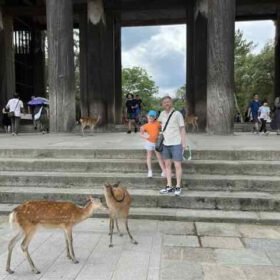
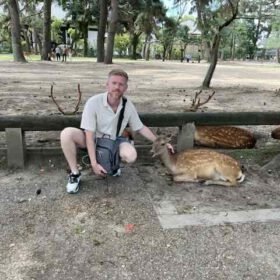
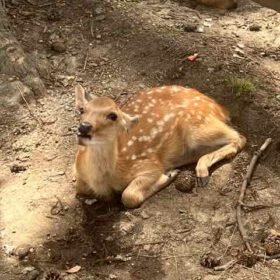
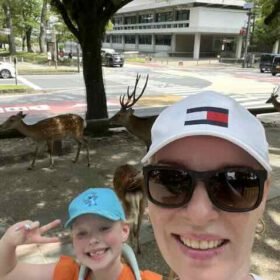
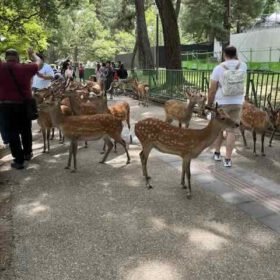
We walked through Nara Park, looking around and taking in the scenery. The deer were everywhere, exactly as promised. Some were lying beneath the trees. Others wandered casually across the paths, completely unconcerned by the tourists walking around them.
The whole setting was beautiful.
Huge old trees.
Green open spaces.
Traditional Japanese buildings appearing between the trees.
Mountains in the distance.
And every now and then, a deer casually crossing your path as if it had somewhere important to be.
Nara Park sits at the foot of Mt. Wakakusa, and the combination of nature, temples and open space makes it feel very different from the cities we had just come from.
We knew about the deer before we went.
Of course we did.
We had seen the pictures.
Children feeding cute little deer.
Deer bowing for crackers.
Families taking photographs with them.
It all looked adorable.
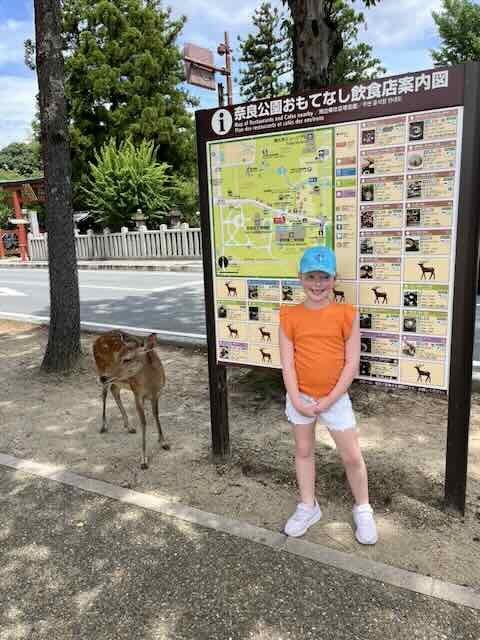
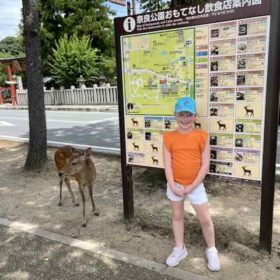
Our oldest daughter, however, had a slightly different opinion.
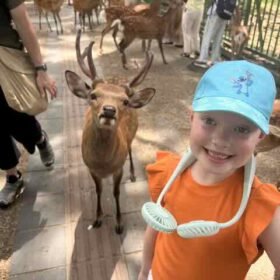
She was eleven when we visited Nara, and she was not a fan of deer.
At all.
And that became rather important.
And then she disappeared
This is the part of the story we still laugh about now.
We were walking along.
The rest of us were looking at the deer, the temples and everything happening around us.
And somehow, without us noticing, our daughter had stopped.
Not walked slower.
Not wandered off to look at something.
Stopped.
Completely.
We carried on for a little while before suddenly realising that we hadn’t heard her voice for a while.
We turned around.
And there she was.
Way behind us.
Just standing there.
Frozen.
There was a deer near her.
Apparently, it had been enough.
She wasn’t screaming. She wasn’t crying. She wasn’t running.
She was simply standing completely still, as if moving might somehow make the situation considerably worse.
And that was the moment my husband realised that this was not going to be solved by shouting, “Come on!”
He had to go back for her.
The hand-holding incident
Now, there is another important detail here.
She was eleven.
And eleven-year-olds do not necessarily appreciate being treated like five-year-olds.
Especially when their parents attempt to hold their hand in public.
But on this particular day, there wasn’t really a discussion.
My husband walked back, took her hand and guided her through the deer.
And she let him.
Which probably tells you everything you need to know about how frightened she actually was.
I can still picture it.
This independent eleven-year-old who had long since decided that holding Mum or Dad’s hand was absolutely unnecessary…
being carefully led through Nara Park by her dad because she was too scared to walk past the deer herself.
It was one of those completely unexpected family moments that you know you will still be talking about years later.
The big temple in Nara
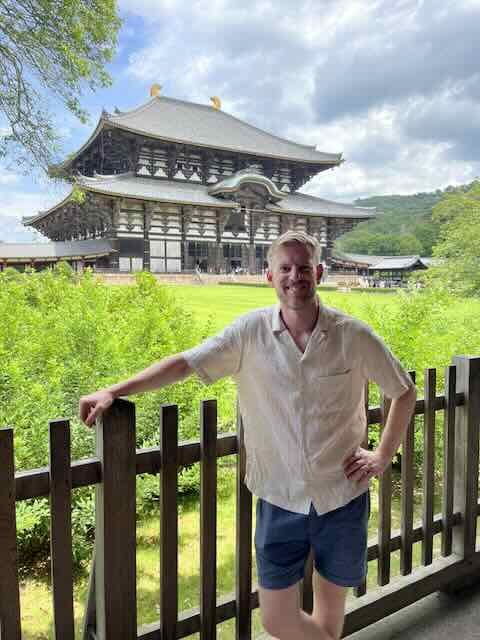
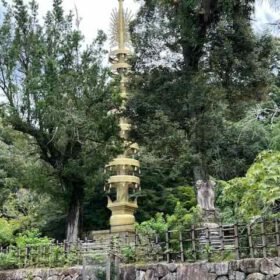
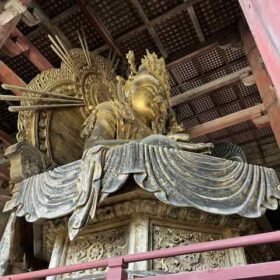
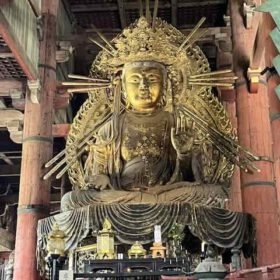
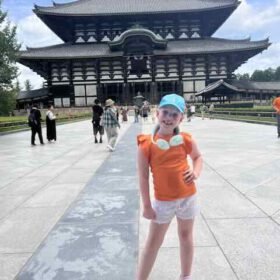
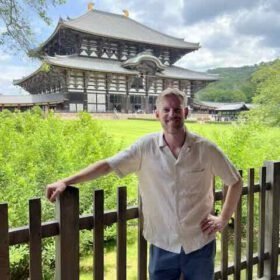
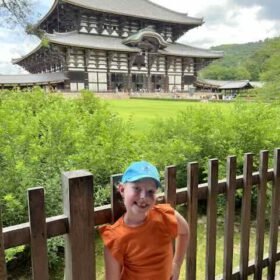
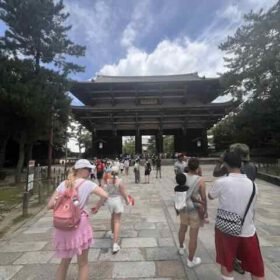
One of the things we had really wanted to see was Tōdai-ji, the enormous Buddhist temple in Nara Park.
And enormous really is the right word.
You approach through the impressive Nandaimon Gate, with its two huge guardian statues, and then the temple comes into view.
It is difficult not to stop for a moment.
The scale is incredible.
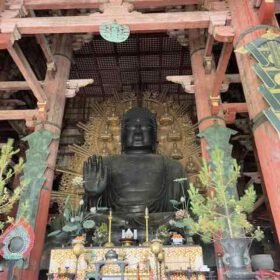
Inside the Great Buddha Hall is the famous Great Buddha, a gigantic bronze statue that stands around 15 metres high. Tōdai-ji is one of Nara’s most important temples and one of the places that really makes you understand just how much history there is in Japan.
And this was one of those moments where even the children were impressed.
Because you don’t need to know anything about Buddhist history to appreciate the size of that building.
You walk inside and look up.
And up.
And up.
The Great Buddha is just enormous.
After all the deer, it was actually nice to have something else to focus on.
Something that wasn’t going to suddenly walk towards you looking for crackers.
But it was the scenery that surprised me
Before visiting Nara, I think I had mainly pictured the deer and the temples.
I hadn’t really thought about how beautiful the surroundings would be.
There is something incredibly peaceful about walking between the old buildings and the trees.
You can hear people talking and children laughing, but then you turn onto another path and suddenly it becomes quiet.
The greenery seems to swallow up the noise.
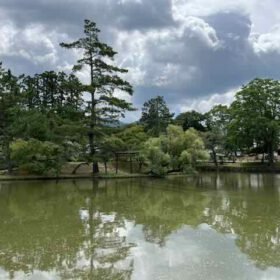
There are little ponds, gardens, wooded paths and beautiful views across the city. Behind Tōdai-ji, you can walk towards Nigatsudo, which has lovely views over Nara.
And this is where Nara felt so different from Tokyo and Osaka.
Those cities had given us neon lights, busy streets, trains, restaurants and crowds.
Nara gave us space.
Space to walk.
Space to look around.
Space to slow down.
It felt almost strange after the constant movement of the bigger cities.
And then, of course, there was always a deer waiting around the corner.
Nara is more than the deer
That is probably the biggest thing I would say about visiting Nara with kids.
Yes, the deer are the obvious attraction.
Yes, they are probably going to be the first thing your children talk about.
And yes, if your children love animals, they may think Nara is the greatest place on earth.
But don’t rush through Nara just to feed the deer and leave again.
The beauty of Nara is the combination of everything.
The ancient temples.
The enormous Tōdai-ji.
The Great Buddha.
The gardens.
The mountains.
The enormous green park.
And those quiet paths where you can simply walk together.
Nara’s official tourism guide even describes the destination as being filled with natural beauty as well as ancient monuments and National Treasures.
And I think that is exactly what stayed with me.
It wasn’t just one spectacular sight.
It was the feeling of walking through this beautiful, ancient landscape and knowing that people had been walking these paths for hundreds of years.
Would we visit Nara with kids again?
Absolutely.
Even with the deer.
Especially because of the deer, actually.
Because when you travel with children, the things you remember years later aren’t always the things you planned.
You remember the unexpected things.
The ridiculous things.
The moments you couldn’t have planned if you tried.
For us, Nara isn’t just the Great Buddha.
It isn’t just Tōdai-ji.
It isn’t even the famous deer.
It is the image of our eleven-year-old daughter standing absolutely motionless several metres behind us while a deer stood nearby.
And then her dad walking back to get her, taking her hand — despite the fact that she was definitely “too old” for hand-holding — and carefully leading her through the deer.
She survived.
She eventually forgave us.
And I suspect she has never looked at a deer quite the same way since.
Nara with kids: our honest take
Nara is one of those places I would definitely include in a family trip through Japan.
If you’re following our Japan with Kids: The Ultimate Family Travel Guide (2026), Nara fits beautifully into the itinerary. You can easily combine it with Kyoto or Osaka, depending on your route.
We loved how different it felt from Tokyo with Kids and Osaka with Kids, and after Nara, moving on to Kyoto with Kids felt like another natural change of pace.
And if you’re travelling around Japan with children, don’t underestimate how much getting from one place to another becomes part of the adventure. Our guide on How to Travel on the Shinkansen with Children is worth reading before you start planning your route.
You can also find more practical tips in our Ultimate Japan Packing List, because travelling around Japan with kids means you’ll quickly discover that comfortable shoes, a sensible day bag and a little planning can make life much easier.
And if your route continues south, our Hiroshima & Miyajima with Kids guide is another stop worth adding to your itinerary.
Because that is what made our Japan trip so special.
It wasn’t one big highlight.
It was all these completely different experiences stitched together.
And somewhere in between all of those incredible places, an eleven-year-old girl who absolutely, positively did not want to walk past a deer.
And sometimes, that’s the story you end up telling years later.